Breastmilk Storage: Putting the CDC and ABM together
By Peaceful Roots Lactation
You pumped the milk. You labeled the bag. Now comes the question almost every pumping parent has asked…
How long is this milk actually good for?
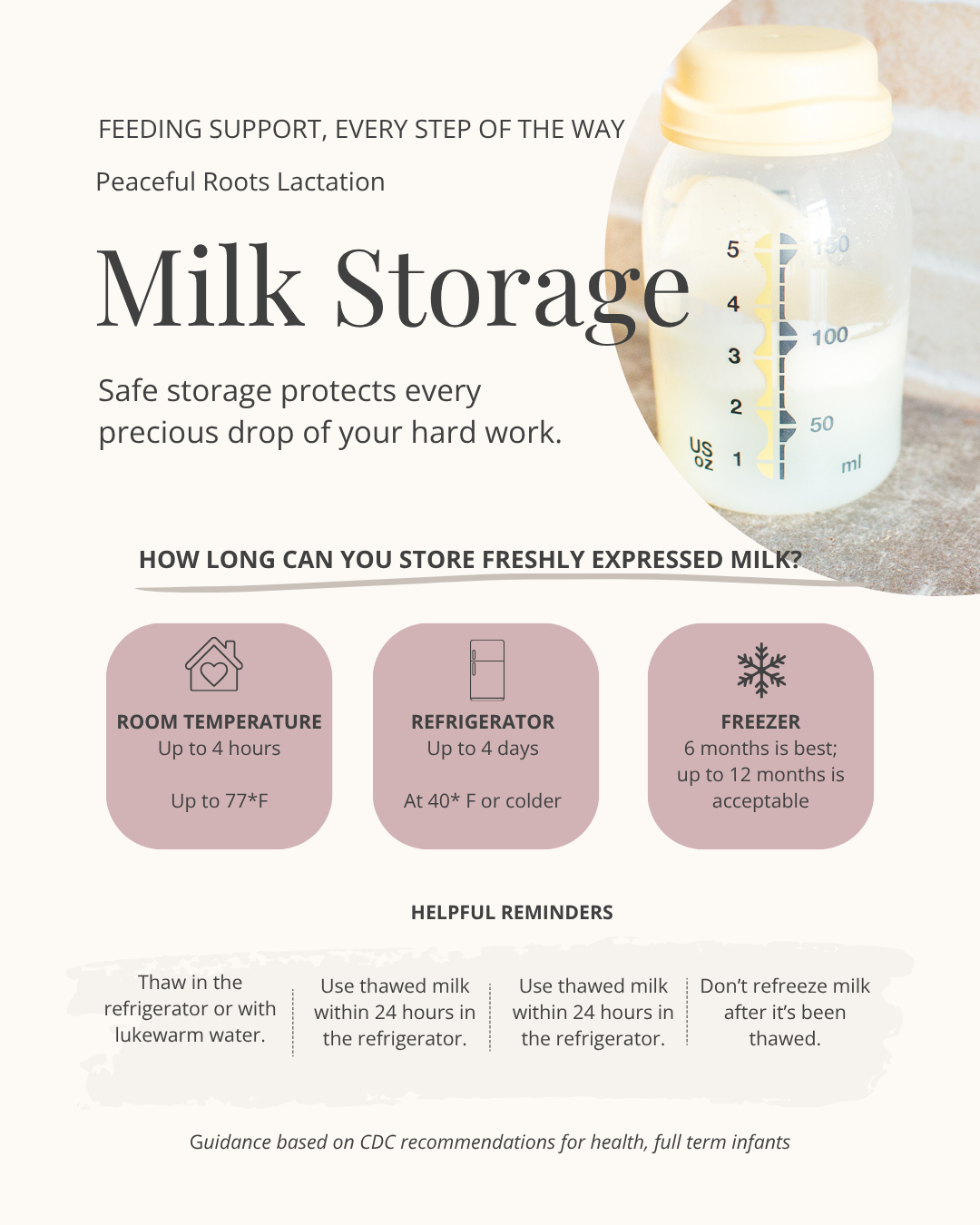
Two trusted sources, the Centers for Disease Control and Prevention (CDC) and the Academy of Breastfeeding Medicine (ABM), offer guidance for safely storing human milk at home. The good news? Their core guidance lines up.
The biggest difference is that the CDC gives families a simple set of practical limits, while ABM adds context about what is optimal versus what may still be acceptable under very clean conditions.
Here’s how to put both together without making milk storage more complicated than it needs to be.
The Simple Rule: Remember 4–4–6
For healthy, full-term infants, an easy starting point for freshly expressed milk is:
4 hours at room temperature
4 days in the refrigerator
6 months in the freezer is best, up to 12 months acceptable.
ABM's optimal recommendations closely align with those numbers, which makes 4–4–6 a useful everyday rule. But ABM gives us a little more context.
Room Temperature: 4 Hours is everyday practice
The CDC recommends keeping freshly expressed milk at room temperature, 77°F (25°C) or colder for up to 4 hours.
ABM also considers 4 hours optimal, but its protocol recognizes that storage time depends on factors such as room temperature and how cleanly the milk was expressed. Under very clean conditions, ABM indicates that 6–8 hours may be acceptable, particularly at cooler room temperatures.
What should parents actually do?
Keep it simple: aim for 4 hours or less.
Think of ABM's longer window as additional clinical context not a reason to routinely leave milk sitting out longer.
And remember: the warmer the environment, the shorter the safe storage time.
Refrigerator: Aim for 4 Days
The CDC recommends storing freshly expressed milk in the refrigerator at approximately 40°F (4°C) for up to 4 days.
ABM similarly considers 4 days optimal, while noting that 5–8 days may be acceptable under very clean conditions.
Again, the simplest everyday recommendation is:
Use refrigerated milk within 4 days.
If you don't think you'll use freshly expressed milk within that window, the CDC recommends freezing it as soon as possible rather than waiting until day four.
Where you put the milk matters, too.
Store milk toward the back of the refrigerator, rather than in the door. Temperatures may fluctuate more when the refrigerator door is repeatedly opened and closed.
Freezer: 6 Months Is Best, 12 Months Is Acceptable
This is one area where the message is especially straightforward both the CDC and ABM guidance aligns with 6 month optimal and 12 month acceptable.
Freezing milk in smaller portions can also make life easier between 2-4 oz. Laying the flat to freeze allows for more room and easy storage.
Fresh Milk vs. Frozen Milk
Freezing is a safe and incredibly useful way to preserve human milk, but ABM offers an important bit of context… fresh milk has biological advantages over frozen milk.
Some components of human milk change during refrigeration and freezing, so when fresh refrigerated milk is available within its safe storage window, there can be benefits to using it rather than automatically reaching for the oldest frozen bag.
That doesn't make frozen milk "bad." Far from it.
It simply means that building the biggest freezer stash possible doesn't have to be the goal.
Can You Combine Milk From Different Pumping Sessions?
This is an area where the details matter.
ABM recommends cooling freshly expressed milk before adding it to milk that is already cold or frozen.
A practical routine is:
Pump → refrigerate → allow the fresh milk to cool → combine once both are chilled.
When combining milk from different pumping sessions, use the date of the oldest milk to guide storage.
How Should Frozen Breast Milk Be Thawed?
The CDC recommends thawing frozen milk:
- Overnight in the refrigerator
- Under lukewarm running water
- In a container of lukewarm water
ABM notes an additional benefit to slower thawing: thawing milk gradually in the refrigerator may result in less fat loss than some faster thawing methods.
Both CDC and ABM support skipping the microwave to warm human milk. Microwaves can heat milk unevenly and create hot spots that could burn baby's mouth. Heating can also affect some of the beneficial components of human milk.
If the fat has separated after storage, that's normal. Gently swirl the container to mix it back together.
How Long Is Milk Good After Thawing?
This is where it's important to start a new clock.
According to the CDC, previously frozen milk that has completely thawed can be stored:
In the refrigerator: up to 24 hours
At room temperature: 1–2 hours
The CDC clarifies that the 24-hour clock begins once the milk is completely thawed, not when you first move the frozen container into the refrigerator. Once thawed milk has been brought to room temperature or warmed, use it within 2 hours.
And once milk has completely thawed you can not refreeze it.
What About Milk Left in Baby's Bottle?
Once baby drinks from a bottle, bacteria from baby's mouth can enter the remaining milk.
The CDC recommends using leftover breast milk within 2 hours after baby has finished feeding. After that, discard what's left.
If throwing away pumped milk makes your heart hurt a little, you're definitely not alone.
One practical strategy is to offer smaller portions first and add more milk if baby is still hungry. That can help protect your stash while still following safe handling practices.
What Does "Very Clean Conditions" Mean?
This phrase is important when interpreting ABM's longer acceptable storage windows.
Those extended times assume careful milk expression and storage practices. That includes things like clean hands, appropriately cleaned pumping equipment, clean storage containers, and proper temperatures. ABM's longer ranges aren't necessarily the best everyday practices for every family.
That's one reason the CDC's simplified recommendations work so well for day-to-day use.
When in doubt, stick with 4–4–6.
A Few Storage Habits That Make Life Easier
Label milk with the date it was expressed.
Keep milk toward the back of the refrigerator or freezer instead of in the door.
Freeze smaller portions so you only thaw what you need.
Use older milk before newer milk when appropriate.
And don't worry if refrigerated or frozen milk separates. Human milk naturally contains fat, and separation during storage is expected.
CDC + ABM: The Bottom Line
The CDC and Academy of Breastfeeding Medicine aren't giving parents two competing sets of rules.
The CDC provides clear limits that are easy to use at home:
4 hours at room temperature.
4 days refrigerated.
6 months frozen is best.
12 months frozen is acceptable.
ABM largely supports those optimal targets while adding clinical context: under very clean conditions and appropriate temperatures, some milk may remain acceptable beyond the optimal room-temperature and refrigerator windows.
For everyday milk storage, 4–4–6 is an easy place to start.
Because milk storage shouldn't feel like another test you have to pass. A few good habits are clean hands and equipment, appropriate temperatures, clear labels, and knowing when the clock starts all help you safely protect the milk you've worked so hard to provide.
This article is for general education and discusses home storage of human milk for healthy, full-term infants. Different recommendations may apply to premature, medically fragile, or hospitalized infants. When you're unsure about milk safety or your baby's individual needs, contact your pediatric healthcare professional or lactation professional.
Sources:
Centers for Disease Control and Prevention, Human Milk Storage Guidelines and Storage and Preparation of Breast Milk
Academy of Breastfeeding Medicine, ABM Clinical Protocol #8: Human Milk Storage Information for Home Use for Full-Term Infants, Revised 2017.